

Still Fighting for Our Lives
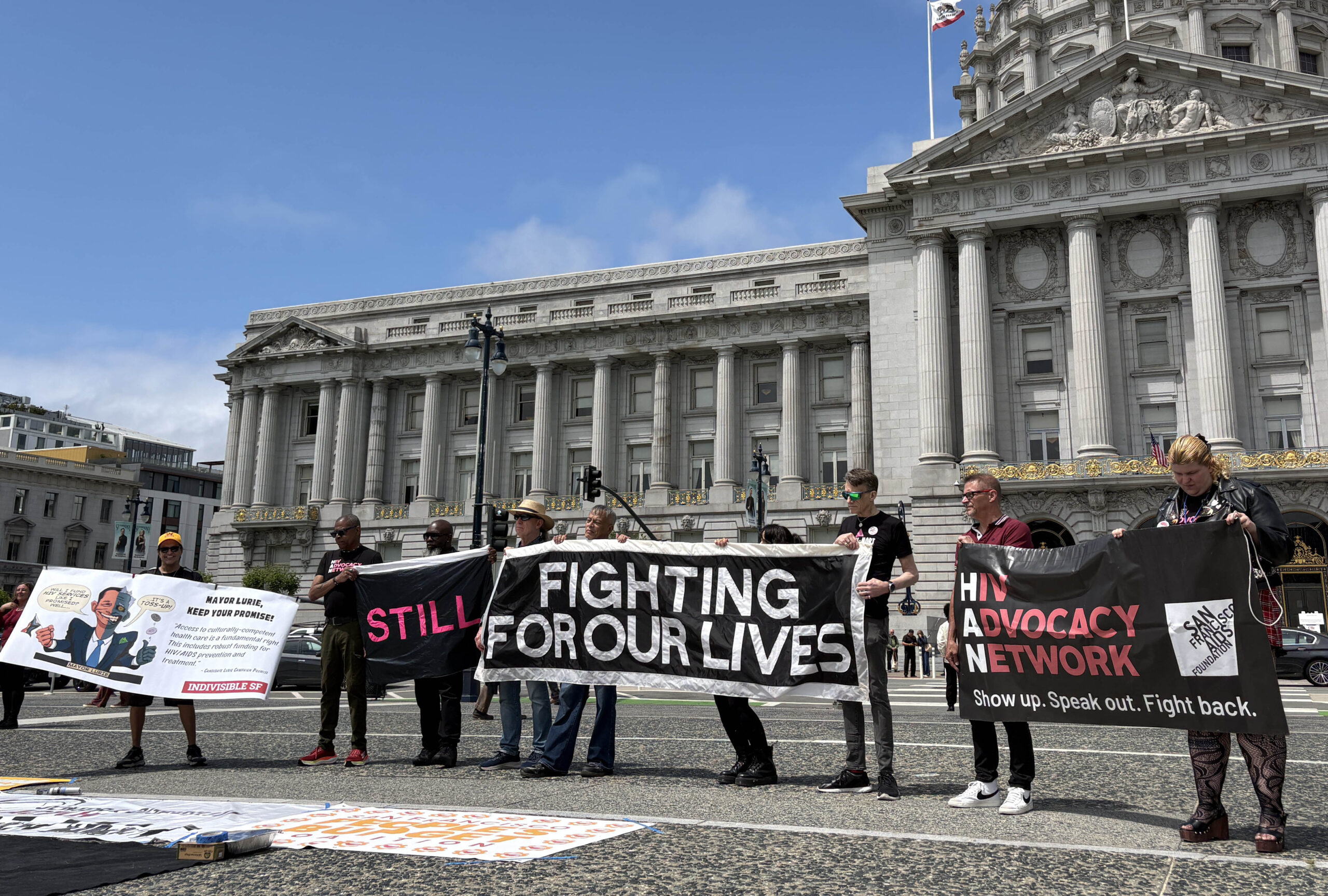
“Wow,” I said, looking down at the banner stretched between our hands. “This banner is older than me.”
Paul smiled.
Without missing a beat, he answered, “Yeah. This banner is older than my HIV.”
We laughed.
Then we didn’t.
It was a strange silence to find in the middle of one of the loudest demonstrations I had ever experienced.
I wouldn’t understand the weight of that silence until later that afternoon, when my friend Justice stood before our coalition and read a Living Obituary. By then, Paul’s joke no longer felt like a joke.
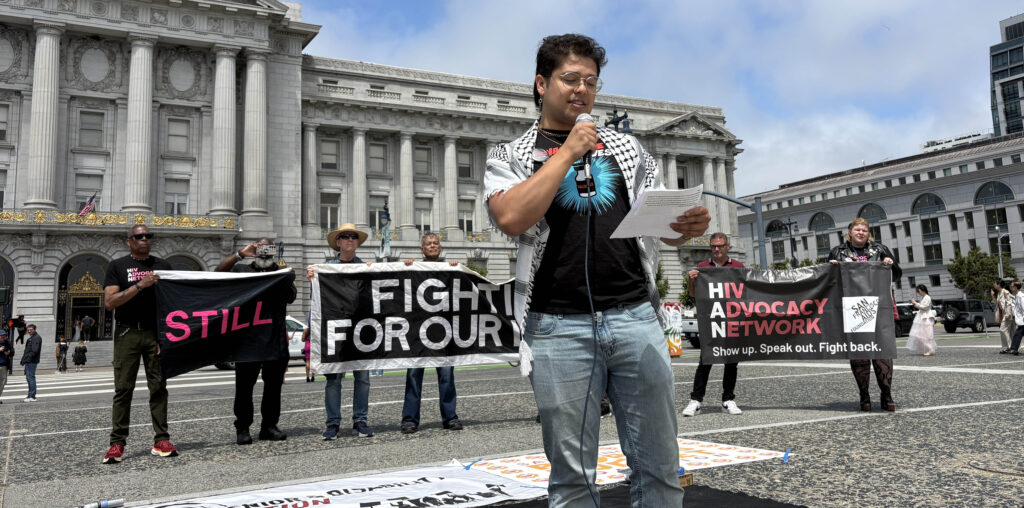
It felt like a warning, as our friend read his own dying words.
Reading a Living Obituary, forcing all of us to confront what happens when systems that keep queer people alive are stripped away. Budgets are never abstract. Every line item has a heartbeat. Every proposed cut has a face.
Around us, chants rose and fell across Civic Center Plaza as coalition members continued arriving outside San Francisco City Hall. Organizers embraced one another after months of emails, strategy calls, public testimony, and relationship building. People passed around water bottles, sunscreen, snacks, and handmade signs while preparing for another day of fighting over San Francisco’s fiscal year 2026–2027 budget.
[June 2026 – People’s Budget Week of Action brought together advocates from HIV organizations, labor unions, disability justice groups, immigrant rights organizations, housing advocates, LGBTQ+ organizations, healthcare providers, artists, and faith communities.]
Everything around us kept moving.
But for a moment, I couldn’t stop looking at the banner in our hands. It had survived longer than I had.
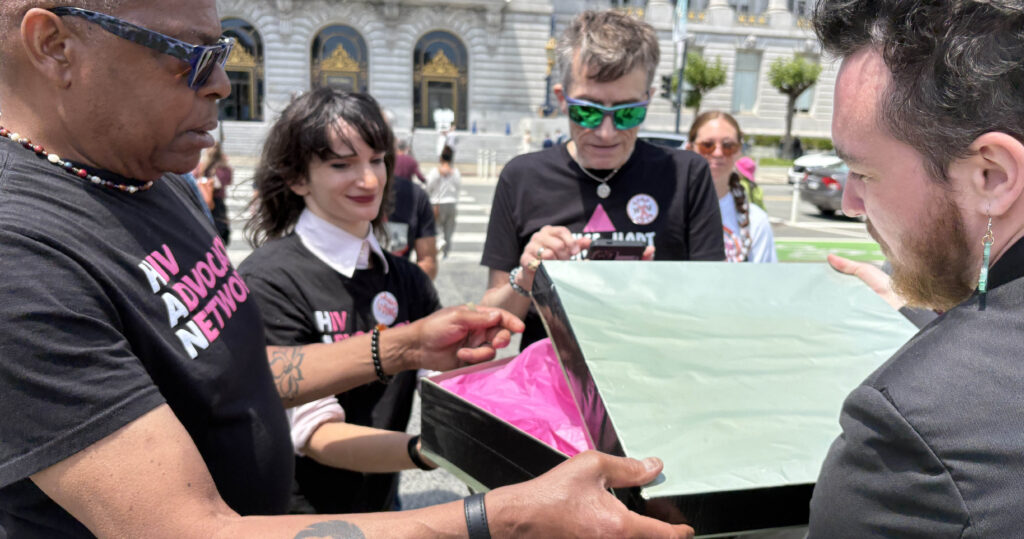
That sentence shouldn’t have carried so much weight, but it did.
The banner wasn’t simply old. It had been carried through the AIDS epidemic by people who organized while attending funerals, sitting beside hospital beds, and refusing to let the world forget. Years later, another generation added a single word: Still.
The first people who carried these banners weren’t simply protesting. They were fighting for access to medication, for hospital visitation, for housing, for dignity, and sometimes simply for someone to acknowledge that they existed.
Many of that generation never lived to see the treatments that exist today. Those banners carry fingerprints from generations of organizers who refused to let HIV become invisible. Holding them in 2026 wasn’t nostalgia. It was a reminder that every generation inherits the unfinished work of the one before it.
[The “FIGHTING FOR OUR LIVES” banner was created in the early 1980s by the Sisters of Perpetual Indulgence, led by Sister Florence Nightmare RN (Bobbi Campbell), for the inaugural People With AIDS March.
The pink “STILL” banner was created by Dear Diva in the mid-2000s for the annual AIDS Candlelight Vigil.
A huge thank you to Dragon King for helping preserve and share this history. These banners are more than protest materials. They are living pieces of our community’s history.]
By Thursday morning, none of us were strangers anymore.
What had started as budget hearings had become a community. Every hallway inside City Hall held another conversation. Every staircase became a strategy meeting. Every patch of shade outside Civic Center Plaza became somewhere to share food, compare testimony, or remind someone to breathe before walking back inside.
The People’s Budget Coalition transformed City Hall into something extraordinary. HIV advocates stood beside labor organizers. Disability justice leaders compared notes with immigrant rights organizers. Housing advocates shared space with healthcare workers, artists, faith leaders, and neighborhood organizers. By the time the Free Speech Event and Cultural Celebration arrived, we had become a coalition in every sense of the word.
An interactive Tree of Life memorial, created by fellow activist Apple Cronk, was a place where community members could write the names of loved ones lost to HIV and AIDS.
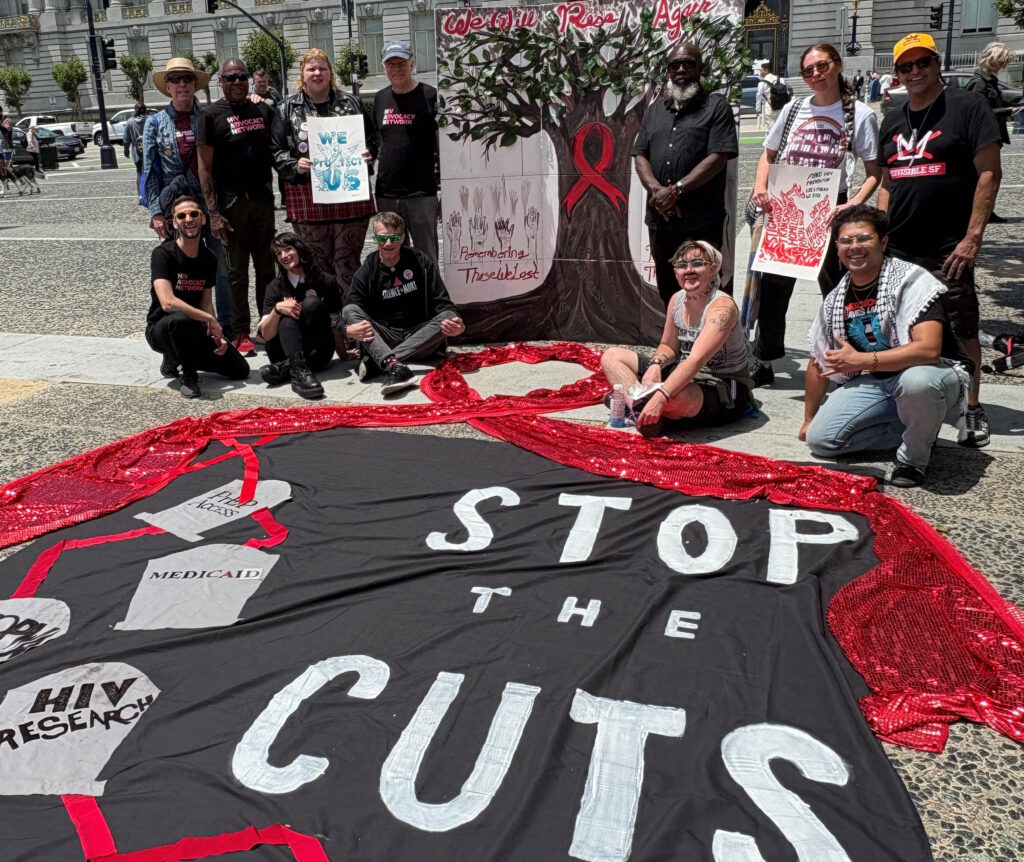
I chose to write the name Alexander Adrieovich Zenoview, someone I was named for, who died of AIDS-related illnesses in 1981. When I transitioned, I actually cut his name in half–that’s where I got Xander from.
This was a way we could remember, grieve, organize, and recommit themselves to keeping one another alive. It was deeply personal, just as this entire budget season had become deeply personal.
Months earlier, I lost my job in the first round of city budget cuts, a simple city memo completely destabilized my world. People hear the word “layoff” and think about a paycheck. I think about the community I lost, the routine, the support systems that were built by a collective understanding of the harm reduction principles.
Last year’s budget decisions showed up in January as a memo identifying programs for reduction. By March, I had lost my job because the agency I worked for could no longer fiscally afford my position.
The Sex Worker Advocacy (SWA) support group I spent 4 years and 7 months helping build was eliminated. Today, there are very limited direct sex work support groups serving the Tenderloin/SOMA–the Lyon Martin Naughty Nurse Mobile is one of the last programs of its kind now that SWA is gone.
Every Wednesday, our room filled with people carrying impossible burdens. Some came because they needed harm reduction supplies. Some needed a hot meal. Some needed help replacing an ID, finding housing, escaping violence, navigating healthcare, or simply sitting in a room where they didn’t have to explain why they survived the way they did.
Sometimes the greatest intervention wasn’t a referral. It was having another sex worker look at you and say, “I’m glad you’re here.” Those relationships don’t show up in budget spreadsheets. They don’t fit neatly into quarterly reports. But they save lives.
There are people I may never see again, and the last time I saw them was at Sex Worker Advocacy. There are people who are gone and no longer a part of this world and the last memory I have with them is in this group.
Losing this group felt like of the biggest betrayals of my life, I built all program materials and resources from scratch. I personally worked on securing our donations (like Plan B), and got extra certifications to handle harder conversations like domestic violence. I consistently held “know your rights trainings” and distributed mutual aid. Anytime a client needed something my motto was “Yes, and…” because I knew how often sex worker needs were ignored by institutions.
Losing that group and being locked out of my research is really what led to my grief collapse, because of who that group was created for and how important it is to show up and show out for our sex worker organizer, especially those of trans experience like myself.
Budgets don’t become real when they’re passed. They become real when you are actively watching your research being thrown away.
As I told the Board of Supervisors during the Bielski-Belenson hearing:
“This was my ability to give back to my community after case manager after case manager decided my life was worth saving.”
For the first time in my professional career, every member of the Capacity Building team was a person of transgender experience. We weren’t simply building programs for transgender communities, we were the experts in the room.
We carried lived experience, professional expertise, institutional knowledge, and years of community trust. We were so incredibly fucking talented. Budget cuts didn’t just eliminate positions.
The scattered relationships, interrupted programs, and dismantled knowledge that took years to build. I still don’t know when I’ll get to experience a team like that again.
When finally I testified before the Board of Supervisors, after months of staying silent, I spoke honestly about what losing my job had done to my life.
I asked the supervisors and their staffers to look me in the eye as I talked about groceries, food stamps cuts, and what it was like to feel like you’re starving.
I talked about uncertainty in my housing status, and looking for the stability that I built for myself since experiencing homelessness during the pandemic. I talked about my fear that more cuts would force more providers, outreach workers, and community members into the same position I was already living.
I thought my testimony ended when I stepped away from the microphone.
Instead, my community answered.
Not quietly.
Loudly.
Long-term survivors, organizers, former coworkers, and friends filled my freezer with meals. They sent me home with leftovers. They handed me groceries and Safeway gift cards. Every time I tried to make myself smaller, they held me accountable to asking for more help. Vince, Paul, Justice, John, and so many others acknowledged my testimony with the deepest form of community care–a full belly.
That changed the way I understand my own story and advocacy. It doesn’t end at the microphone. Sometimes advocacy looks like public testimony. Sometimes it looks like calling a supervisor. Sometimes it looks like carrying a historic HIV banner. Sometimes it looks like making sure the organizer standing beside you has enough food to come back tomorrow.
We fought like hell to save our services, visits to our board of supervisors, phone banking, letters, emails, demonstrations, and taking the fight to the board of supervisors themselves.
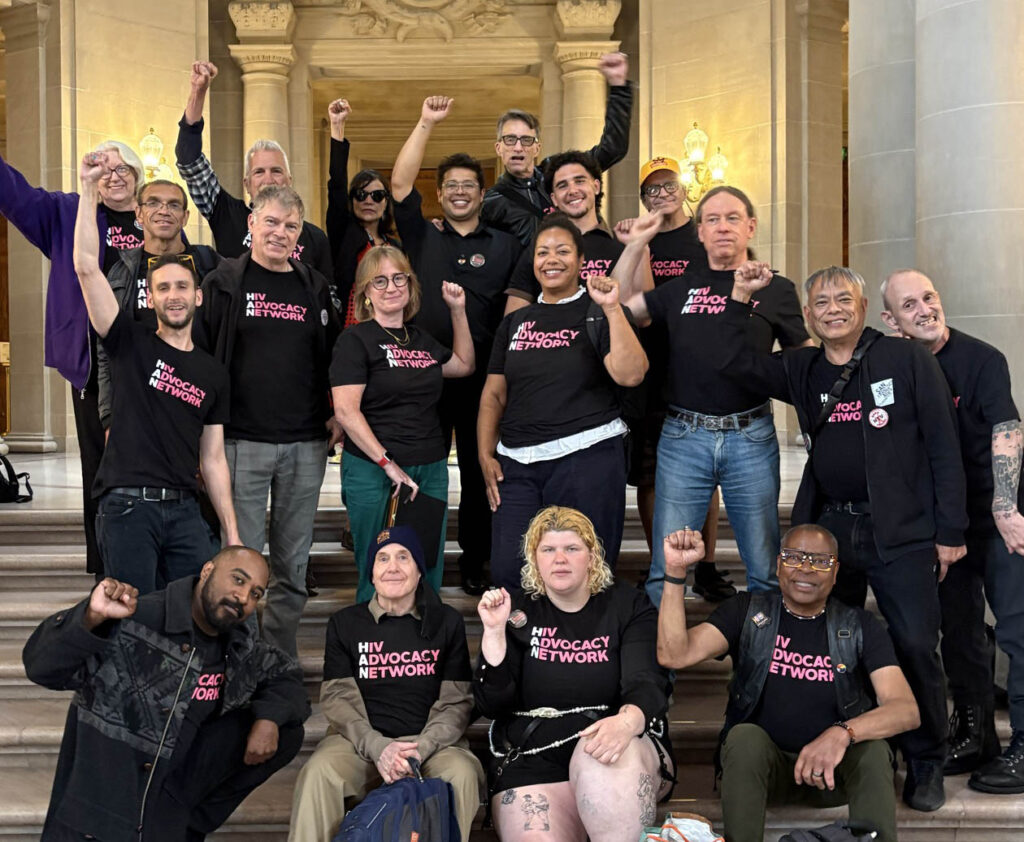
Public Comment day and “add back day” I can tell you I visited multiple supervisors offices coming in hot, because I finally reached my limit. I felt tired of begging for our dignity, I felt tired of being pushed out of the room as a transgender sex worker, I felt tired of not being listened to.
What really kills me is that as we activists poured our hearts and souls into these testimonies, it still felt like I was screaming at a wall. There were moments where I questioned whether we were even being listened to. So I raised my voice.
Days later after the fight was said and done, when the budget process concluded, we celebrated that the People’s Budget Coalition secured major restorations for HIV prevention, harm reduction, trans-led services, HIV and aging programs, mobile healthcare, LGBTQ+ services, and community-based care.
Final add-backs included funding for HIV prevention through all seven Health Access Points, Lyon-Martin mobile services, Strut Clinical Services, Ryan White provider support, HIV & Aging services, and $2 million for trans-led services.
We should celebrate those victories.
We earned them.
But we should also tell the truth.
The funding was restored.
The nervous systems weren’t.
Every budget season asks long-term survivors to revisit unimaginable grief. Every proposed cut asks communities to prove, once again, that our lives are worth investing in. Our communities were grieving and living through their PTSD on such a public stage.
My hope is that one day another organizer unfolds this banner, laughs at how old it is, and doesn’t immediately understand why Paul’s joke hurt.
Until then, we are still fighting for our lives.
_________