



Heated Rivalry Is Everywhere. Should Straight People Watch It?
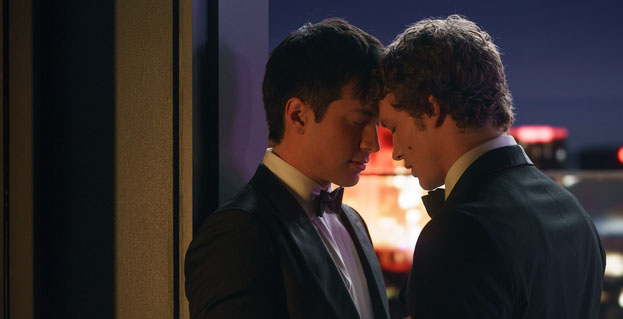
From SNL punchlines to Andy Cohen and Anderson Cooper’s giggly New Year’s Eve banter on CNN, Heated Rivalry has become a tsunami. Everyone’s talking about it. Even my aunt asked me last week: “Should I watch Heated Rivalry?” I gagged. I’ve hit my limit.
It’s the way Heated Rivalry is sliding into the mainstream lexicon as if it’s a witty punchline, shorthand for “oh, that gay stuff.” To some extent, it’s cute that straight people think they finally have a pop culture crib sheet for gay sex, but let’s be honest—Heated Rivalry is about to become the first and last stamp in their gay sex passport. Straight people aren’t critically interrogating the subtext to Heated Rivalry, and they are—which is quite dangerous—vulnerable to making wild generalizations about what gay sex really is.
Let’s break it down. The series stars Connor Storrie and Hudson Williams, who play Ilya Rozanov, a Russian hockey player, and Shane Hollander, his fiercest rival, who happens to be half white/half Asian. Their on-ice aggression turns into off-ice, well, aggression, in the form of a steamy, competitive romance. There’s a lot of sex. Like, a lot a lot. Sex practically becomes a third character.
Here’s where it all starts to wobble: Ilya refuses to bottom. Shane, meanwhile, is cast as the perennial bottom. This isn’t just boring. It’s bad sex and bad character development. Good gay sex isn’t about rigid roles, and yet, Heated Rivalry seems desperate to fit its characters into neat heteronormative boxes. But, hey, I don’t expect straight folks to call this out, because straight folks love boxes and they want us in their little categories. “Are you a bottom or a top?” “Are you a pitcher or a catcher?” But the beauty of queer sex is that it doesn’t have to work that way.
And let’s talk about race: Why is it always the Asian guy who ends up cast as the bottom? It plays out on porn too: like why are so many of the most famous gay Asian porn starts portrayed as submissive? There’s a whole conversation to be had about fetishization and the way the show’s dynamics reinforce tired (and frankly, lazy) tropes.
Taking it a step further: in Heated Rivalry the white gay couple in the subplot seem to move at warp speed. Scott Hunter, played by François Arnaud, and Kip Grady, played by Robbie G.K leap over emotional hurdles with the kind of ease usually reserved for sitcoms and fairy tales. Meanwhile, Ilya’s dom top energy comes with a side of disrespect that Shane is expected to tolerate. Is it easier for two white guys to request what they want and get it from each other? Is Ilya’s allure as a ‘top’ and his whiteness allow him to get away with more in his relationship with Shane? Why is it that Shane is portrayed as submissive in both the bedroom and outside the bedroom?
There may only be one thing I can concede to Heated Rivalry. Yes, the show was written by a woman, and at its core, it’s a rom-com. Traditionally, rom-coms invite viewers—especially straight women—to pick a side, to root for the heroine, to imagine themselves as the protagonist, swept up in the drama and desire. For decades, the genre’s appeal has hinged on letting women see themselves at the center of the love story, navigating the emotional rollercoaster from meet-cute to happy ending.
I wonder if Heated Rivalry flips the dynamic for straight women watching. They get to watch a romance unfold without being asked to insert themselves into it. Sit back, enjoy the drama, the tension, the banter—and, yes, the sex—at a comfortable distance. It’s almost like watching a sport rather than being one of the players (ah-em).
For me, though, this didn’t feel like a spectator sport. It’s supposed to reflect our lives as gay men, our relationships, our sex. And yet, what’s on screen often felt questionable at best, almost alien, shaped by the same female gaze and narrative conventions that have always defined straight rom-coms. The sex, the emotional beats, the power dynamics—none of it felt true. Instead, it felt like someone else’s fantasy, projected onto our bodies and relationships.
Back to the original question: “Should I watch Heated Rivalry?” Watch it if you want—just don’t send me a text asking, “So, is this how it really is?” Unless you want a response worthy of a TED talk.