

Forty-Five Years Later: Health Is Still Primary
On June 5, 1981, a brief report appeared in the CDC’s Morbidity and Mortality Weekly Report describing five young gay men in Los Angeles diagnosed with a rare form of pneumonia.
A few paragraphs.
A few patients.
A warning that few fully understood at the time.
Today, forty-five years later, we know what came next.
More than 45 million people around the world have died from AIDS-related illness.
Forty-five years.
Forty-five million lives.
Forty-five million reasons why we must never forget.
As someone living with HIV, as the first Black CEO and one of the first openly living with HIV leaders of San Francisco AIDS Foundation, and as someone who has dedicated my career to LGBTQ+ health, June 5 is not simply a date on a calendar. It is a reminder of both our greatest losses and our greatest acts of courage.
It is a reminder of a generation that refused to disappear.
A generation that transformed grief into action.
A generation that demanded the world recognize that our lives mattered.
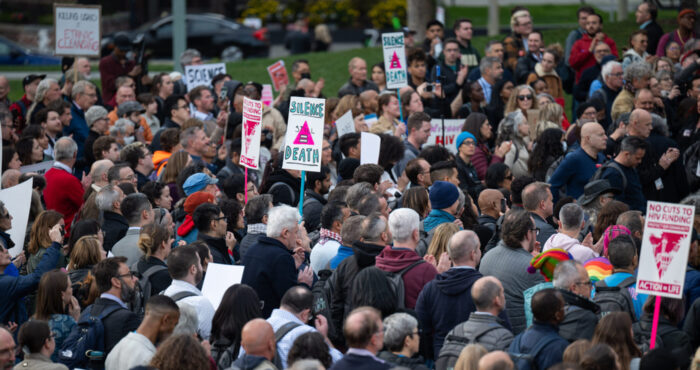
The HIV movement changed the course of history. Activists, clinicians, researchers, people living with HIV, and LGBTQ+ communities built one of the most powerful public health movements the world has ever seen. They challenged indifference. They challenged stigma. They challenged governments that were willing to let people die.
And because they fought, millions of people are alive today.
But anniversaries are not only about looking backward.
They are about asking ourselves what this moment requires of us now.
Because forty-five years after the first reported cases of AIDS, we once again find ourselves in a political environment where science is being questioned, public health systems are under attack, LGBTQ+ people are being targeted, and healthcare access is increasingly treated as a political bargaining chip rather than a human right.
Today, that work is sustained by a vast network of community partners—health centers, advocacy organizations, housing providers, harm reduction programs, faith communities, researchers, and grassroots leaders—working together to meet people where they are. Just as the HIV movement was never built by a single organization, protecting the health of our communities requires collaboration, trust, and a shared commitment to equity. These partnerships strengthen our collective ability to respond to emerging challenges and ensure that no one is left behind.
Across the country, organizations like San Francisco AIDS Foundation and our partners are confronting a reality that feels deeply familiar.
We are once again being asked to defend the health and humanity of our communities.
The difference is that this time we know what is at stake.
We know what happens when public health is ignored.
We know what happens when ideology overrides science.
We know what happens when governments retreat from their responsibility to protect the people they serve.
And we know who bears the consequences.
It is NOT the powerful.
It is the people already navigating inequity, stigma, poverty, racism, homophobia, transphobia, housing instability, and barriers to healthcare.
That is why the message behind Seven Days in June resonates so deeply: Health is Primary.
Health is primary because every other issue depends on it.
Health is primary because a person cannot thrive without access to care.
Health is primary because public health infrastructure saves lives whether people notice it or not.
Health is primary because HIV prevention, HIV treatment, mental health services, substance use care, gender-affirming care, sexual health services, housing support, and community connection are not luxuries. They are essential.
And health is primary because every person deserves the opportunity to live with dignity.
The organizations serving LGBTQ+ communities today stand on the shoulders of those who came before us. The activists who chained themselves to government buildings. The healthcare workers who showed up when others would not. The people living with HIV who demanded a seat at every table where decisions were being made.
I also find myself thinking about the lesbians who became a lifeline during the darkest years of the epidemic. Long before many institutions responded, lesbian communities showed up. They cared for people dying of AIDS when others were too afraid. They organized, advocated, fundraised, comforted, and fought alongside gay men and people living with HIV. They were warriors in every sense of the word. Their courage helped sustain a generation, and their contributions deserve far greater recognition in the story of how our communities survived.
They taught us that silence is not an option.
They taught us that visibility matters.
They taught us that community is often our greatest source of strength.
As we mark this forty-fifth anniversary, I find myself thinking not only about those we lost, but about those who are still here.
The long-term survivors.
The caregivers.
The advocates.
The researchers.
The healthcare workers.
The next generation of leaders.
The young people who deserve to inherit a world where access to healthcare is expanding, not shrinking.
Their future is worth fighting for.
And that is what makes this moment so important.
The lessons of the AIDS epidemic were never just about HIV.
They were about what happens when fear is allowed to dictate policy.
They were about who gets left behind when healthcare is treated as a privilege instead of a right.
They were about the extraordinary power of communities to organize, care for one another, and demand better.
Those lessons matter today as attacks on LGBTQ+ rights intensify, as public health funding faces unprecedented threats, as HIV prevention and treatment programs face uncertainty, and as many of the very systems our communities depend upon are increasingly politicized.
We cannot afford to forget what history has taught us.
We cannot afford to grow complacent.
And we cannot allow the hard-won gains of the last forty-five years to be dismantled.
Forty-five years after the first MMWR report, our responsibility remains clear.
We must protect the progress that generations fought to achieve.
We must continue advocating for evidence-based public health.
We must defend healthcare access for all people.
We must ensure that LGBTQ+ communities, people living with HIV, and every marginalized community are seen, valued, and cared for.
Most importantly, we must remember that the story of HIV has never only been a story of loss.
It is also a story of resilience.
A story of love.
A story of community.
A story of people refusing to give up on one another.
Forty-five years later, that spirit remains alive.
And neither the HIV movement nor the communities it serves are done fighting.
Because health is primary.
And because every life is worth protecting.