




2025 HIV Policy Wins! (And one loss)

While California’s legislative session officially ended last month, the session really ended last Tuesday, the deadline for Governor Newsom to sign or veto bills that the state legislature had passed (or passively let them become law by not doing anything).
As we shared in March, San Francisco AIDS Foundation sponsored four bills this year. The legislature passed them all. Governor Newsom signed three of them, but unfortunately vetoed the fourth. Here’s the rundown of what these now-laws will do–and how Gov. Newsom’s veto will keep Californians who want PrEP from getting it.
Good news: Senate Bill 41–Signed
Authored by Senators Scott Weiner and Aisha Wahab
We’re pleased that the governor signed SB 41, since the bill will help bring down HIV drug costs.
SB 41 bans a number of practices commonly engaged in by companies called pharmacy benefit managers (PBMs for short). PBMs are supposed to negotiate with pharmaceutical manufacturers on behalf of insurance companies to lower drug costs for those companies’ customers. In reality, though, they take most of the savings they negotiate for themselves, and they contribute to higher drug prices–including already high prices for HIV drugs.

PBMs create other barriers to HIV drugs, too: For example, one of the country’s largest PBMs, CVS Caremark, recently refused to recommend to the insurance companies it works with to cover Yeztugo, the new, twice-a-year injectable form of PrEP. SB 41 prohibits some of the worst behavior by these companies, which will help improve the affordability and accessibility of HIV drugs.
Good news: Senate Bill 278–Signed
Authored by Senator Christopher Cabaldon
More good news! SB 278 will improve care for people living with HIV on Medi-Cal, California’s Medicaid program, by changing a law about the sharing of HIV-related data.
That law prevented managed-care plans (MCPs), the organizations that coordinate care for Medi-Cal members, from obtaining data on the viral loads of their members living with HIV. This, in turn, kept MCPs from being able to identify members who are not virally suppressed and offer them additional resources, such as case management.

SB 278 removed this barrier while maintaining strong privacy protections around the data, clearing the way for MCPs to provide more support for the approximately 10,000 people living with HIV on Medi-Cal who are not virally suppressed.
Good news: Assembly Bill 309–Signed
Authored by Assemblymember Rick Zbur
Thank you to all the advocates who pushed forward this common-sense bill to continue effective HIV prevention. AB 309 made permanent a law that allows people age 18 or older to get clean needles and syringes from pharmacists and physicians without a prescription.
Letting people who inject drugs get clean equipment from doctors and pharmacists helps them avoid sharing needles, and in that way prevents the spread of HIV, hepatitis C, and other infectious diseases. The law permitting this practice was set to expire on January 1, 2026, but AB 309 removed that expiration date.
Bad news: Assembly Bill 554–Vetoed
Authored by Assemblymembers Mark Gonzalez and Matt Haney
This is a difficult loss, for all of us who want to see more people be able to easily access new PrEP medications.
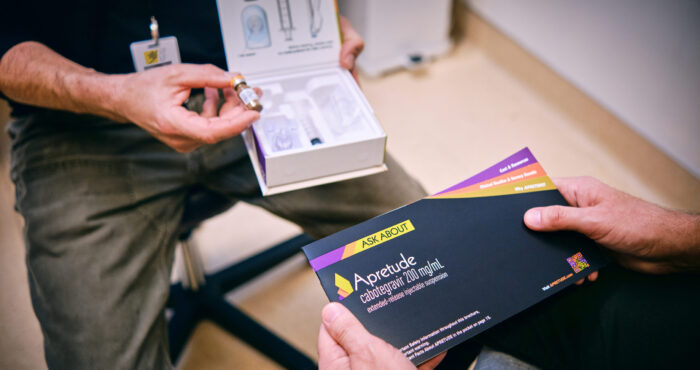
The most important part of AB 554 would have helped more healthcare providers–especially providers serving people with low income–offer newer, injectable forms of PrEP that only have to be taken once every two to six months.
Right now, providers have to buy injectable PrEP and then get reimbursed for it by insurance companies after they give it to a patient. Injectable PrEP is expensive, so many providers can’t afford to buy it up front like that. As a result, a lot of providers can’t offer this powerful HIV-prevention tool–especially providers at facilities with low funding, like public-health clinics.

AB 554 would have solved this problem by requiring insurance companies, not healthcare providers, to pay for injectable PrEP up front, like they do for PrEP that comes in the form of a pill.
As you might expect, insurers lobbied against this bill, and Governor Newsom sided with these powerful corporations. His veto will make it harder for Californians who need PrEP to get it, even as almost 5,000 people in our state are newly diagnosed with HIV every year.
Bonus: Assembly Bill 144–Signed
SFAF didn’t sponsor this multi-part health bill, but we came up with and advocated for a part of the bill that strengthened protections for no-cost insurance coverage of PrEP, STI tests, and other preventive health services. Previously, most insurance companies were required to cover preventive services at no cost to their members if those services are recommended by a federal task force called the U.S. Preventive Services Task Force (USPSTF). The problem is, the recommendations of the USPSTF are at risk of being changed for the worse–or eliminated entirely–by the Trump administration, judging by the way the administration has already weakened recommendations by a similar group, the Advisory Committee on Immunization Practices.
To mitigate this risk, we proposed changing California law to require no-cost coverage of preventive services recommended by the USPSTF as of January 1, 2025, before President Trump took office. The legislature adopted our proposal, basically “freezing” the USPSTF recommendations like they were on January 1 of this year. Legislators also gave the California Department of Public Health the power to change or add to the recommendations so that the state can remain flexible.
Now, thanks to our advocacy and lawmakers’ collaboration, any meddling by the Trump administration in the USPSTF will not affect Californians’ ability to access PrEP and other preventive care without co-pays or other cost-sharing.
A successful session
With the exception of the veto of AB 554, the 2025 legislative session was enormously successful for SFAF’s Public Policy team. On top of the above bills, we also helped secure $65 million in the state budget to replace any federal funding for HIV services that is eliminated, plus $10 million for California’s hepatitis C and STI prevention work.
Our team couldn’t get these results if decision-makers didn’t know that behind us is a large, passionate community of HIV advocates, so thank you to those of you who called or emailed your legislators when we put out a call to action, or otherwise showed your support. We’ll need your help again in 2026! To stay informed about our advocacy, please sign up for SFAF’s newsletter or join our HIV Advocacy Network.